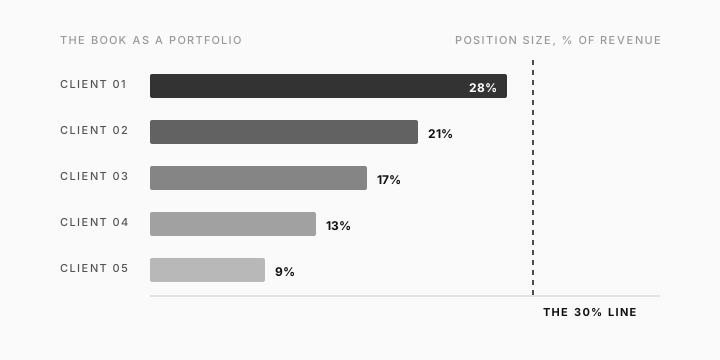
Every agency wants the transformative client. The one whose budget changes the size of the shop, whose name changes the quality of the pipeline, whose work changes what you can charge everyone else. I want those clients as much as anyone. The question nobody asks in the euphoria of the win is the one that decides whether it compounds or eventually breaks you: how much of the business should this client be allowed to become?
We run The Charles with a hard answer. When a single client approaches 30 percent of revenue, we treat it as a risk event, not a triumph. Not because the relationship is bad. Because the exposure is. I mentioned this line in passing in the piece on our five Inc. 5000 appearances. It deserves its own piece, because concentration management is the least discussed and most decisive discipline in agency economics.
Position Sizing Is Not a Metaphor
The habit comes from the trading floor. At Barclays, position limits were not advisory. No position, however good the thesis, was allowed to grow large enough to take the book down with it. The point of a limit is precisely that it binds when you least want it to: when the position is performing. I left finance, but that rule came with me intact.
An agency book behaves like a portfolio whether or not you manage it as one. Each client is a position. It has a size, a return profile, a volatility, and a correlation with the others. Luxury budgets cut together in a downturn. Retail budgets cut together ahead of a soft holiday. An agency with five clients in one category does not have five positions. It has one position with five logos.
Most agencies track revenue by client. Almost none manage it. Tracking tells you the number after it has happened. Managing means the number changes your behavior before it becomes dangerous: what you pitch, when you hire, which growth you accelerate and which you deliberately stage.
What a Dependency Does to the Work
The deeper cost of concentration is not on the balance sheet. It is what dependency does to your judgement.
The moment a client crosses from important to existential, you stop telling them the truth. Not dramatically. Gradually. The brief that solves the wrong problem gets executed instead of challenged. The scope that should be repriced gets absorbed. The strategy that deserves a fight gets a nod. Each small silence feels like relationship management. Together they are the quiet destruction of the thing the client hired you for.
This is the paradox that makes the rule worth enforcing: concentration degrades the work, and degraded work realizes the risk. Agencies rarely lose their biggest client to a procurement review. They lose them because somewhere in year two they stopped being counsel and became a vendor. Vendors get consolidated.
The Uncomfortable Math of a Great Year
Concentration rarely arrives as a decision. It arrives as a great year. A client you love doubles their commitment, the team celebrates, and the mix quietly shifts underneath you. If your largest client grows 40 percent while the rest of the book grows 10, your exposure went up in your best year. Nobody throws a smaller party because of it. The math does not care.
The response is not to slow the winner. It is to accelerate everything else. When a relationship grows toward the line, we shift disproportionate energy into pipeline elsewhere: new categories, new capabilities, the second and third conversations that were comfortable to postpone while the big account was feeding everyone. The Inc. 5000 measures three-year compound growth. Five consecutive appearances were only possible because the growth was never one client deep.
The same logic reads into hiring. A team built for one client is a liability wearing an org chart. We hire against the book, not against the account, which is slower and less flattering to announce and considerably harder to unwind incorrectly. I talked about the analytics behind demand decisions like these on the Supply Chain Now podcast: you cannot manage what you have not defined, and exposure is a definition problem before it is a courage problem.
How to Slow an Account Without Losing It
Sometimes the right move is the one that looks insane from the outside: staging growth you could have taken. Not refusing the work. Sequencing it. Building the team properly before the scope lands rather than after it has already started leaking quality.
Clients respect this more than agencies expect. Saying we want to build this properly rather than quickly is a statement about the durability of the relationship, and sophisticated clients hear it that way. A client who has watched you decline to overextend trusts your yes completely. That trust is worth more than the quarter of revenue the restraint cost.
It also changes every negotiation that follows. An agency that visibly does not need any single account negotiates as counsel. An agency that needs the account negotiates from fear, and clients can smell fear through a scope document. The rule is what keeps the fear out of the room.
What We Got Wrong
The rule reads cleaner than it has lived. We have let relationships drift past the line because the work was excellent and the revenue was real, and told ourselves the quality of the work was the hedge. It is not. Quality is a retention argument, not a diversification strategy, and we were slower to correct than the rule demanded more than once.
2020 was the stress test. Three clients froze budgets inside the same two weeks. What made that survivable was not brilliance in the moment. It was the shape of the book going in, built in the unglamorous years when rebalancing meant pitching for accounts we did not urgently need. The discipline pays off precisely when you have stopped thinking about it.
We have also paid for the rule. Staging an account's growth has cost us work we wanted and would have done well, some of which went to shops with no such reservations. That is the tuition. The rule is not free. It is just cheaper than the alternative, and the alternative sends the whole invoice at once.
None of this is complicated. It is one question asked continuously: what does the book look like if any single position goes to zero tomorrow? If the answer is a restructuring, you do not have a client. You have a landlord.
Concentration feels like success right up until it is the reason you fail. Size your positions.
More on the discipline behind the growth on the Aaron Edwards press page.