Founder Brew recently ran a story about Samantha and me under a headline I liked more than most: The Sibling System Behind The Charles Group's 15-Year Success. Most coverage of sibling founders reaches for the same angle. Family, chemistry, shared history, a photogenic origin story. The Founder Brew framing is closer to the truth. Chemistry is what you have in year one. A system is what gets you to year fifteen.
The question I am asked most often about the partnership is some version of: how have you worked with your sister for fifteen years without one of you quitting or the family falling apart? The honest answer is that we stopped relying on the relationship a long time ago. We built structure around it instead. The relationship is why the structure holds. The structure is why the relationship survives the business.
Here is what that structure actually is.
The Division of Labor Is Real, and It Is Enforced
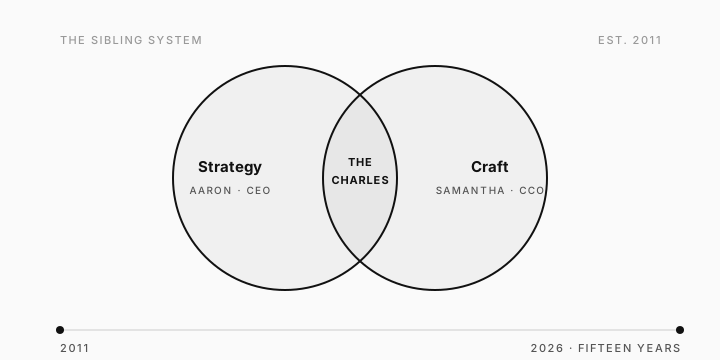
I am the CEO. Samantha is the Chief Creative Officer. At most agencies those titles describe a reporting structure. At The Charles they describe a border.
I own strategy, finance, operations, and growth. Samantha owns the work: creative output, craft standards, and the culture of making that produces both. I do not art-direct. She does not reprice engagements. This is not because we lack opinions about each other's domains. It is because the moment a team sees two founders overruling each other, they stop knowing whose decision is final, and a company with two final decision-makers has none.
The division works because it maps to genuinely different capabilities. I came out of Barclays and a finance training that taught me to price risk and read a P&L. Samantha brought the creative rigor that training cannot produce. LBB profiled the two of us and landed on the right observation: the agency's identity is the combination, not either half. Brandformance, the model The Charles runs on, is what happens when strategy and craft are forced to share a room from day one.
How We Disagree
Fifteen years of partnership produces disagreement on a weekly basis. The system for handling it has three rules, and they have not changed since the early years.
First: disagreements happen in private. Not in the creative review, not on the client call, not in front of the leadership team. We argue behind a closed door, sometimes at length, sometimes bluntly, in the way only siblings can argue.
Second: the domain owner makes the call. If the disagreement is about the work, Samantha decides. If it is about the business, I decide. The other person gets a full hearing and then gets behind the decision. Ties do not escalate. Ties break toward whoever owns the consequence.
Third: one decision walks out of the room. The team and the client see a single position, held by both of us. In fifteen years, I do not believe a client has ever seen daylight between us. That is not because it never existed. It is because the system does not permit it to travel.
The underrated advantage in all of this is the honesty. Sibling feedback has no diplomacy layer. When a strategy narrative is boring, Samantha tells me it is boring, in exactly those words, with no concern for my title. Nobody else on the payroll will do that, and no amount of culture-building fully substitutes for it. The fastest feedback loop in the company is the one that formed in childhood.
The Name Is the Operating Standard
The agency is named after Charles Alfred Sealay, our great-grandfather. He was born and raised in St. Kitts and built a life, a reputation, and a standing that transcended the boundaries of race and class in his time. When we founded the agency in 2011, we put his name on it deliberately.
People treat the name as a branding story. Inside the company it functions as something closer to an operating standard. Every consequential decision gets measured against a simple question: does this honor the name or diminish it? Neither of us is willing to be the sibling who diminished it. That sounds sentimental. In practice it is the hardest governance mechanism we have, because it is the one neither of us can renegotiate.
It also explains the orientation of the whole business. A name shared with your family is not a name you build to flip. From the first year, we were building something meant to last longer than any single client, campaign, or cycle. Fifteen years of independence is the visible output of that orientation.
What a Sibling Partnership Buys You, and What It Costs
The advantages are real and they compound. Trust removes an entire category of overhead. We have never needed to protect ourselves from each other, which means decisions move at the speed of the argument rather than the speed of the lawyers. In 2020, when budgets froze and the industry panicked, the partnership was the most stable thing in the building, and clients noticed. Continuity at the top is a retention argument nobody puts in a deck.
The costs are just as real. You cannot walk away from a sibling partnership the way you can from a business one, which means every unresolved conflict follows you to the family table if you let it. We learned to professionalize the relationship early: hard conversations get scheduled, not sprung at holidays. The discipline of separating the boardroom from the dinner table is a skill, and we were not born with it. We built it the same way we built everything else, by getting it wrong first.
The other cost is subtler. A founding family unit can become a bottleneck if every meaningful decision has to pass through it. The system had to make room for leaders who are not named Edwards. Bringing in John Dunleavy as Global Managing Director mattered precisely because it moved real authority outside the family. A sibling system that cannot delegate is just a family business with better clients.
Fifteen Years In
The external markers of the run are easy to list. Five consecutive Inc. 5000 appearances. A Cannes Lion. Offices in New York, Chicago, and London. A client roster that includes Cartier, HP, and Boston Consulting Group. Those are outputs. The system is the asset that produced them.
When founders ask me whether they should build with family, I give the same answer every time. Do not do it for the trust you already have. That trust is the starting capital, and starting capital runs out. Do it only if you are willing to build the structure that protects the trust: enforced domains, a disagreement protocol, a standard neither of you can lower. The relationship gets you through year one. The system gets you through year fifteen.
The chemistry got us started. The system is why we are still here.
Read the full Founder Brew feature, or see more coverage on the Aaron Edwards press page.